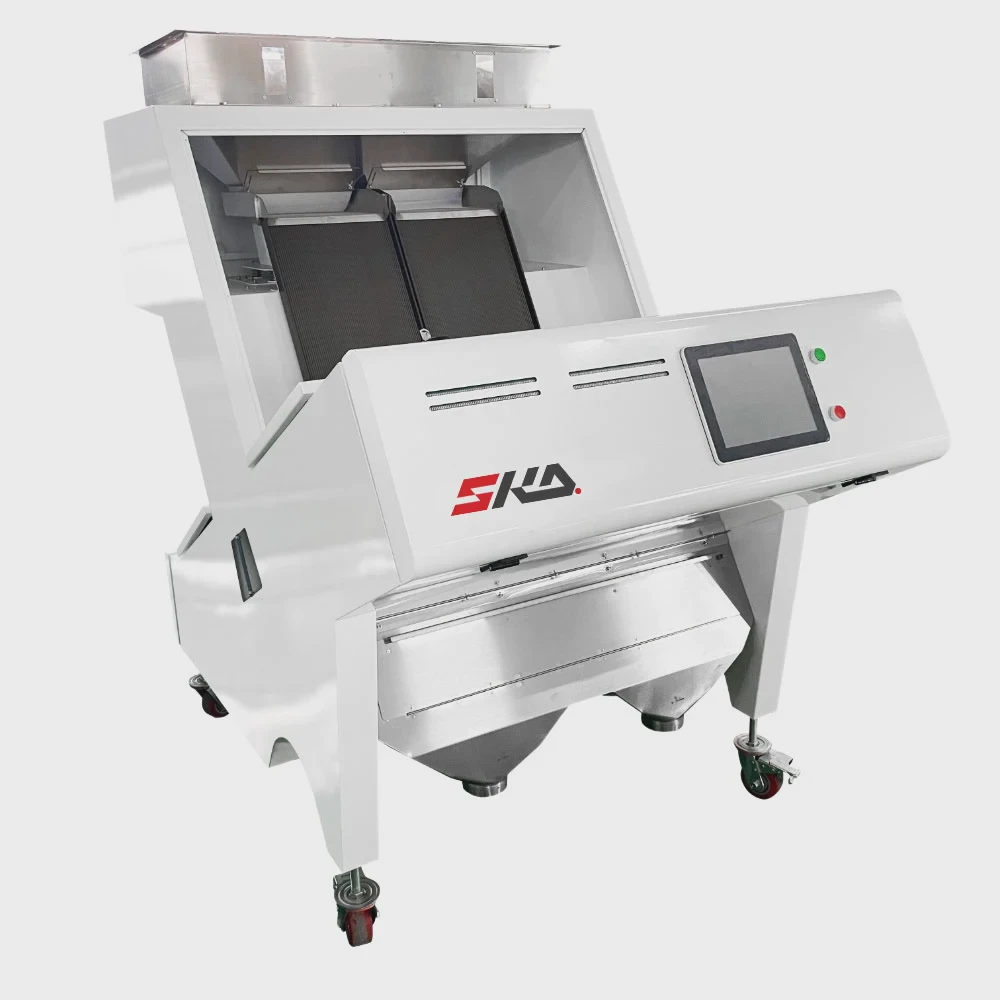
Coffee Color Sorter Buying Guide: 8 Factors to Check Before You Invest
Coffee Color Sorter Buying Guide: 8 Factors to Check Before You Invest
Buying a coffee color sorter is one of the largest capital decisions a coffee processor will make. Get it right and you ship export-grade lots with consistent quality; get it wrong and you are paying for re-runs, rejected shipments, and a machine that does not match your throughput. This coffee color sorter buying guide walks you through the eight factors that matter most — capacity, bean type, defect spectrum, accuracy, optical technology, take-out ratio, physical fit, and after-sales support — so you can match the machine to your line, not the other way around.
Why a Coffee Color Sorter Is Worth the Investment
Manual picking can remove obvious defects, but it cannot keep up with the subtle color variations that determine specialty grade. A modern coffee sorting machine inspects every single bean, in real time, using full-color cameras and AI-trained models. The result is consistent defect removal at industrial throughput — typically 99.9% sorting accuracy on standard material, with no fatigue, no shift changes, and no training curve.
For exporters and roasters, that consistency translates directly into price. A lot with unstable defect rates loses buyers; a lot that meets export standards on every shipment wins repeat contracts. The question is not whether to invest in a coffee bean sorter, but how to choose the right one.
The 8 Factors You Must Evaluate
1. Throughput Capacity (TPH) — Match the Machine to Your Line
Capacity is the first spec to lock down. A machine that is too small creates a queue at the sorter; a machine that is too big wastes capital and floor space. Look at your peak daily volume, not your average, and pick a sorter that can run comfortably at 70–80% of its rated capacity during your busiest shift.
| Processor Profile | Hourly Throughput You Need | Suitable Machine Class |
|---|---|---|
| Specialty roaster / sample roaster | 30–60 kg/h | Mini / lab sorter |
| Small mill or single-origin processor | 0.3–0.5 T/h | Mid-range sorter (32–64 air holes) |
| Mid-size exporter | 0.5–1 T/h | Industrial sorter (64–128 air holes) |
| Large industrial line | 1 T/h and above | Multi-chute industrial sorter |
2. Bean Type — Green vs Roasted, and Variety
Not every coffee color sorter handles both green and roasted beans equally well. Green coffee is denser, has more uniform color, and tolerates higher drop heights. Roasted coffee is darker, more brittle, and demands gentler handling. If your line processes both, ask the manufacturer for documented test runs on each, not just one.
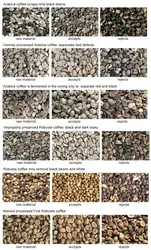
Variety matters too. Robusta and Arabica have different defect profiles — Robusta tends to have more insect-damaged and black beans, while Arabica tends to show more sour and immature beans. A sorter with a wide defect library and AI learn-mode will switch between varieties faster than a fixed-threshold machine.
3. Defect Spectrum — What the Sorter Must Catch
Before comparing brands, list every defect category your buyers penalize. A typical export-grade spec covers:
- Black beans (over-fermented or burned)
- Sour beans (under-fermented or fungal)
- Moldy beans
- Insect-damaged beans
- Broken / chipped beans
- Immature or unripe beans
- Shell fragments and husks
- Foreign matter (stones, sticks, glass, metal)
Confirm with the supplier that every category on your list is covered by the sorter's standard defect library, and ask whether the AI model can be trained on your own reference samples for edge cases.
4. Sorting Accuracy — Read the Fine Print
Sorting accuracy is the most quoted and most misunderstood spec. When a manufacturer writes 99.9%, read the conditions: it almost always means "measured on standard material" — a clean, well-graded sample used as a benchmark. Real-world accuracy on a difficult lot (high defect rate, mixed varieties, humid material) will be lower.
Ask the supplier for:
- The exact material used in the accuracy test
- Test methodology (single-pass vs multi-pass, defect density, throughput)
- Real-world case studies, ideally from your target export market
SKA coffee color sorters are rated at 99.9% accuracy on standard material; on tough lots, field performance is typically between 97% and 99%, depending on defect density.
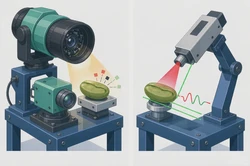
5. Optical Technology — CCD, NIR, and AI Vision
There are three generations of optical sorting technology on the market:
- CCD (Charge-Coupled Device) — full-color cameras that identify surface color differences. Mature, reliable, and the most common choice for coffee.
- NIR (Near-Infrared) — detects moisture content and material composition. Useful for foreign-matter separation but not a substitute for color sorting on coffee.
- AI Vision — trained models that learn bean profiles and adapt to new defect patterns in real time. Best for processors handling multiple varieties or quality tiers.
For most coffee processors, a CCD + AI vision combination is the right answer. NIR is a complement, not a replacement.
6. Take-Out Ratio — Protecting Good-Bean Yield
Take-out ratio is the ratio of good beans that get ejected along with defects. A 30:1 ratio means that for every 30 good beans removed, only 1 good bean is mistakenly ejected. Higher is better — it means less waste, better yield, and higher revenue per ton.
Take-out ratio is also a measure of optical and ejection precision. A well-engineered machine with high-resolution cameras and short-reaction-time valves will hit 30:1 or better; a cheaper machine may drop to 10:1, costing you yield on every batch.
7. Footprint, Weight, and Power
Physical fit is often the most underestimated factor. Before you sign a purchase order, measure your processing room doorways, ceiling height, floor load capacity, and power supply. Three questions to ask the supplier:
- What are the unpackaged dimensions and weight?
- What is the power draw, voltage, and phase?
- What is the air-source pressure and consumption (most coffee color sorters need 0.6–0.8 MPa compressed air)?
Compact models like the SKA-16 (330 × 700 × 1000 mm, 30–60 kg/h) fit into tight roastery spaces; industrial models like the SKA-2A128 (1152 × 1697 × 1708 mm, 1 T/h) need a dedicated processing room with reinforced flooring.
8. After-Sales Support, Warranty, and Spare Parts
A coffee color sorter is a precision optical instrument. Over a 10-year service life, you will need replacement valves, filters, lights, and (eventually) cameras. Ask the supplier:
- What is the standard warranty period and what does it cover?
- Are spare parts stocked locally, or shipped from the factory?
- Is remote diagnostics available? Can an engineer log in and tune the machine from offsite?
- What is the typical lead time for a replacement part?
A 12-month warranty and remote-support capability should be the minimum you accept; 24 months is better.
How SKA Coffee Sorters Match These Eight Factors
SKA Machinery builds four coffee color sorters covering the full capacity range from boutique roastery to industrial export line. Here is how each model maps to the eight factors above.
Small-Scale: MINI Coffee Color Sorter SKA-16
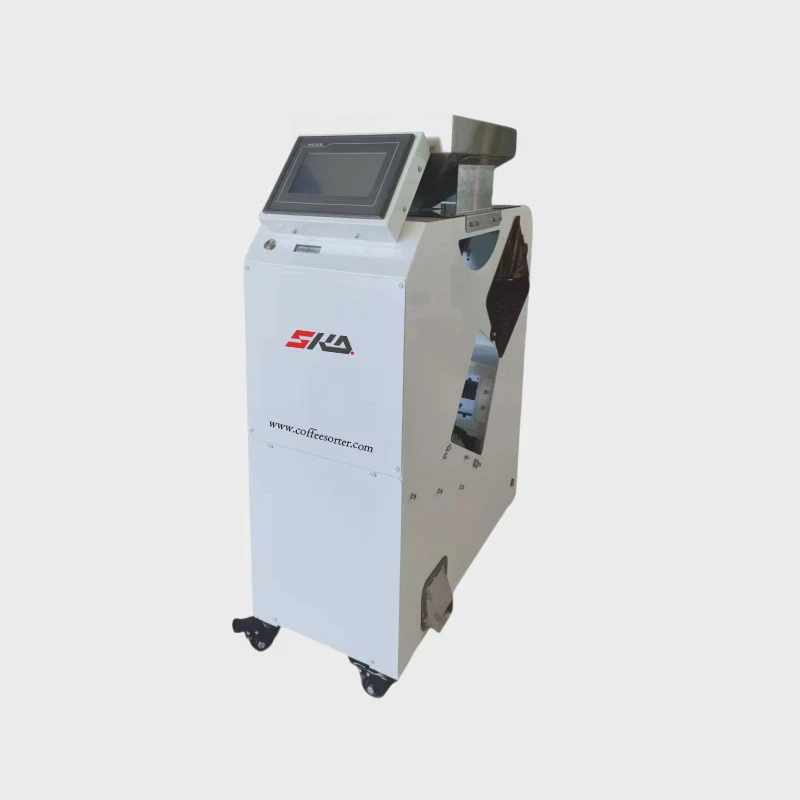
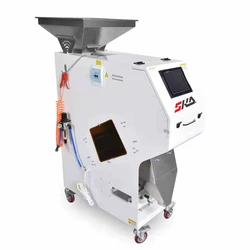
The SKA-16 is the entry-level sorter for specialty roasters, sample roasters, and small wet/dry mills. With a 30–60 kg/h throughput, 0.2 kW power draw, and a 330 × 700 × 1000 mm footprint, it fits into a corner of any roastery. It uses full-color CCD detection with AI-powered recognition to remove black, sour, moldy, and insect-damaged beans from both green and roasted coffee at 99.9% accuracy on standard material.
Mid-Range: SKA-32 and SKA-1A64
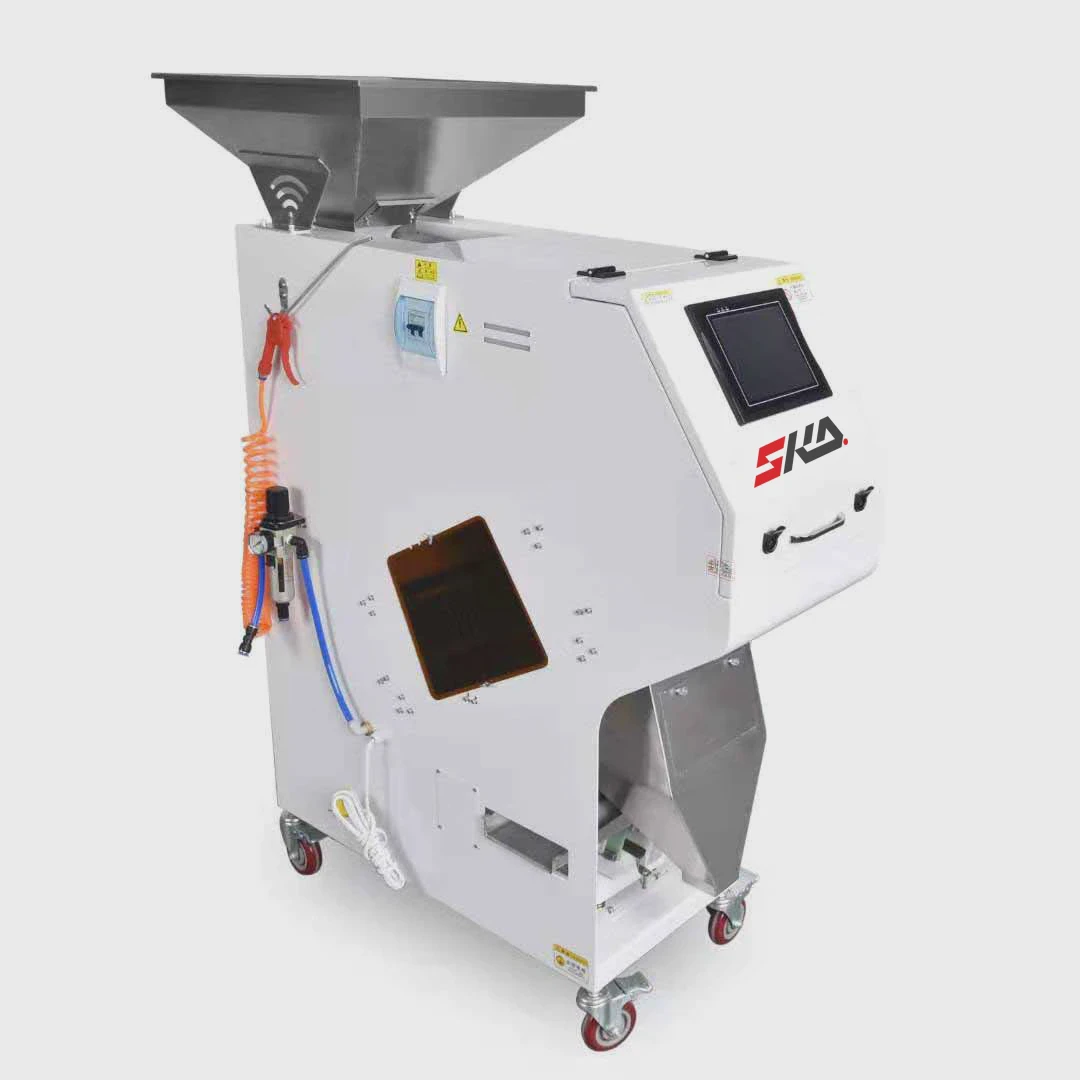
The SKA-32 is built for small export batches and specialty processors that need laboratory-grade precision in a compact unit. 32 air holes, 0.3 T/h throughput, 0.7 kW power, 105 kg weight, 30:1 take-out ratio. It handles both green and roasted coffee with a 99.9% accuracy rating on standard material.
The SKA-1A64 steps up to 64 air holes and 0.3–0.5 T/h throughput for growing processors and mid-size mills. The extra air holes mean higher-resolution, multi-angle detection — a real advantage on lots with mixed defect types. 1 kW power, 160 kg, 30:1 take-out ratio.
Industrial: SKA-2A128
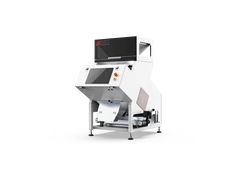
The SKA-2A128 is the high-throughput choice for industrial export lines. 128 air holes, 1 T/h throughput, 1.8 kW power, 320 kg, robust steel construction for continuous operation in humid processing environments. The 30:1 take-out ratio keeps good-bean yield high even at full line speed.
Quick Comparison: SKA Coffee Color Sorter Models
| Parameter | SKA-16 | SKA-32 | SKA-1A64 | SKA-2A128 |
|---|---|---|---|---|
| Throughput | 30–60 kg/h | 0.3 T/h | 0.3–0.5 T/h | 1 T/h |
| Air holes | — | 32 | 64 | 128 |
| Accuracy (standard material) | 99.9% | 99.9% | 99.9% | 99.9% |
| Take-out ratio | — | 30:1 | 30:1 | 30:1 |
| Power | 0.2 kW | 0.7 kW | 1 kW | 1.8 kW |
| Weight | — | 105 kg | 160 kg | 320 kg |
| Best fit | Roastery / lab | Small export batches | Mid-size mill | Industrial line |
Real-World Result: A Vietnam Exporter Case
How do these factors translate into actual export performance? In a recent case, a Vietnamese coffee exporter paired an SKA color sorter into a wet-mill line and cut defect rates by 88% on export-bound Robusta lots. The change moved two of their key buyers from spot contracts to annual supply agreements. Read the full case study.
Frequently Asked Questions
What is the difference between CCD and NIR coffee sorters?
CCD cameras detect surface color differences; NIR detects moisture and composition. For coffee, CCD with AI vision is the primary technology; NIR is a complement for foreign-matter separation, not a substitute.
Can one sorter handle both green and roasted coffee?
Yes, modern CCD + AI sorters like the SKA series switch between green and roasted profiles through pre-set programs. Confirm with the supplier that both modes are factory-tested, not just claimed.
How much does a coffee color sorter cost?
Pricing depends on throughput, air-hole count, and configuration. See our 2026 coffee color sorter price guide for the factors that drive cost, or request a quote for your specific capacity.
What is a realistic payback period?
Most mid-size processors recover the investment in 12 to 36 months through reduced labor costs, lower rejection rates, and premium export pricing. Read our ROI calculation example for the math.
Next Steps — Request a Quote
Choosing the right coffee color sorter is a strategic decision, not just a procurement one. Share your daily throughput, the varieties you process, and the defect categories your buyers penalize, and SKA will recommend a configuration with documented test data, not just a brochure. Request a quote or reach us on WhatsApp for a fast response.