Coffee Defect Rate Testing: How to Verify Sorter Performance Before You Buy
Every color sorter brochure quotes high accuracy. Some say 99.9 percent. Others say 99.99 percent. Very few of them say what the number was measured on, and that omission is where most buying mistakes start.
If you are evaluating a coffee color sorter, the useful question is not how accurate it is. It is how that was measured, on what material, and whether it holds on your beans at your throughput. This article covers the numbers that actually transfer between suppliers, and how to test a machine on your own coffee before you commit.
Why accuracy numbers are hard to compare
A detection rate only means something when four things come with it.
The material it was measured on. Rice and plastic pellets sort easily and look impressive in demo videos. Green coffee is harder. The colour range inside a single lot is wide, and defects often sit close to the accept range.
The defect concentration in the test sample. A machine catching 99 percent of defects in a sample that is 20 percent defective is doing a far easier job than one catching 95 percent in a lot that is 1 percent defective. As defect concentration drops, false ejections start to dominate the result.
Single pass or second pass. Running product through the machine twice improves purity and cuts throughput roughly in half. Always ask which one the figure refers to.
What counted as a defect. Black beans, sour beans, insect damage and foreign material are not equally easy to see, and suppliers differ on which categories they include in their test.
When a supplier cannot answer those four questions, the percentage is marketing.
What defect rate means in practice
Before comparing machines, agree on how defects are counted. Three variables change the result on the same lot.
Sample size. Specialty grading under the SCA green coffee standard works on a 350 gram sample. Many commercial export contracts specify a different sample weight and their own tolerance table. Small samples give unstable numbers: sort 3 kg and pull 350 g, and you can get different answers from different scoops.
Counting method. Defects are expressed either as a percentage by count (how many beans out of a thousand) or by weight (how many grams out of a kilo). A few large stones move the weight number hard and barely move the count. State which one your buyer uses. For a full list of defect types, see common coffee bean defects and how to remove them.
Defect categories. Primary defects such as full black, full sour, dried cherry or fungus damage are weighted differently from secondary ones such as partial sour, shell or broken. One full black bean and five broken beans are not the same quality problem, even though both count as defects.
Write the method down and use the same method before and after installation. Otherwise you end up arguing about numbers instead of fixing quality.
The three numbers that matter
Detection rate. The share of actual defects the machine ejects. This is the number suppliers advertise.
Carry-out, also called false ejection or good product loss. The saleable beans thrown out along with the defects. This is the number that costs you money, and it rarely appears in the brochure. On a 2 ton per hour line, a carry-out of 1 percent is 20 kg of saleable coffee per hour. Multiply that across a harvest season and compare it with the price of the machine. The result surprises people.
Throughput at your rejection target. Rated capacity is measured under easy conditions. What you need is the throughput the machine holds while hitting your target defect rate on your material. Ask for that number explicitly, in writing.
These three pull against each other. Raise the sensitivity and you catch more defects while ejecting more good beans. Push throughput up and both numbers get worse. No setting maximises all three, so decide which one you can afford to lose. For most specialty coffee, carry-out bites first. For high volume commercial lots, throughput does. Our coffee sorter capacity guide covers the throughput side in more detail.
What a color sorter removes, and what it does not
Being clear about the limits saves a lot of disappointment after installation.
A CCD sorter separates by visible colour, size and shape. That covers black beans, sour beans, mould damage, most insect damage, shells, sticks, stones and foreign material that differs in colour from the bean. The sensor choice matters here, and we compare the options in CCD vs NIR coffee color sorters.
It does not catch everything. Defects that look fine on the outside, such as internal mould or fermentation damage, pass straight through. Foreign material the same colour as your beans will not separate on colour alone. Cup quality is untouched: a sorter will not remove a ferment or a phenol taint, because that is a chemistry problem rather than an optical one. Moisture and density differences need NIR rather than visible light.
A sorter makes good coffee consistent. It does not make bad coffee good.
How to test a machine on your own coffee
Sample testing is the cheapest insurance you can buy, and most suppliers will do it free. To make the results useful:
Send 5 to 10 kg of representative material, not your cleanest lot. Include the defects you actually struggle with and say which they are. A sample of good beans proves nothing.
State your target specification: throughput in kg or tons per hour, target defect rate after sorting, and the defect categories your buyer cares about.
Ask for a report that lists the material description, moisture content, hand sorted baseline defect count, single or double pass, achieved throughput, achieved defect rate, and the share of good beans found in the reject stream.
Ask for video of the run, or watch it live. A written number with no run behind it is easy to produce.
Repeat the test after installation, using the same method. Keep the records. Lot to lot comparison is the only way to know whether your settings have drifted.
Put the acceptance criteria in writing
Before payment, agree on the target defect rate and how it is measured, maximum carry-out, throughput at that defect rate, which material the test used, who handles installation and calibration, operator training, spare parts lead time, and response time when something fails mid harvest.
That list takes an hour to write and removes most disputes later.
How we handle this at SKA
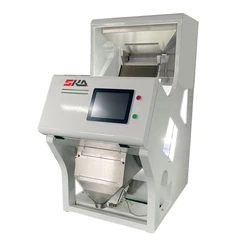
We build coffee color sorters at our own factory in Anhui, with sales, export and after sales support handled from Ningbo. The range runs from 30 kg per hour to 2.5 tons per hour, manufactured under ISO 9001 and CE certified.
We do not print a single accuracy percentage in our brochures, because the honest answer depends on your beans. Instead we sort a sample of your material and send you the report: what went in, what came out, how much good product went with it, and at what throughput. If the numbers do not justify the purchase, we would rather say so than take the order.
See the coffee color sorter range, or send us a sample to test. We answer all enquiries within 24 hours.