Small vs Industrial Coffee Color Sorter: Which Fits Your Mill
Small vs Industrial Coffee Color Sorter: Which Fits Your Mill
A small coffee color sorter and an industrial machine differ in throughput, obviously. What decides your satisfaction after delivery is the other four things: the power hookup, the floor space, the air supply, and what happens to your schedule when the sorter gives out. We have watched buyers chase tons-per-hour numbers, then park a 1 t/h machine in a room with a single wall outlet. This guide sorts the decision the way we work through it with customers.
Capacity is the least interesting difference
Rated throughput is easy to compare, so everyone starts there. The harder numbers are what a machine costs you when the lots are small, when the staff is thin, and when the harvest peak lasts six weeks out of the year.
A roastery handling 200 kg of micro-lot per week and an export mill running 8 t a day have the same defect problem in different shapes. The first needs a machine that turns on, holds a recipe and takes no floor. The second needs one that survives an eight-hour shift run by an operator with three other jobs.
Where a small coffee color sorter earns its keep
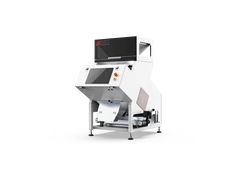
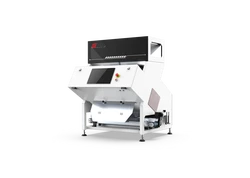
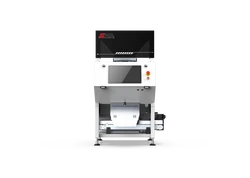
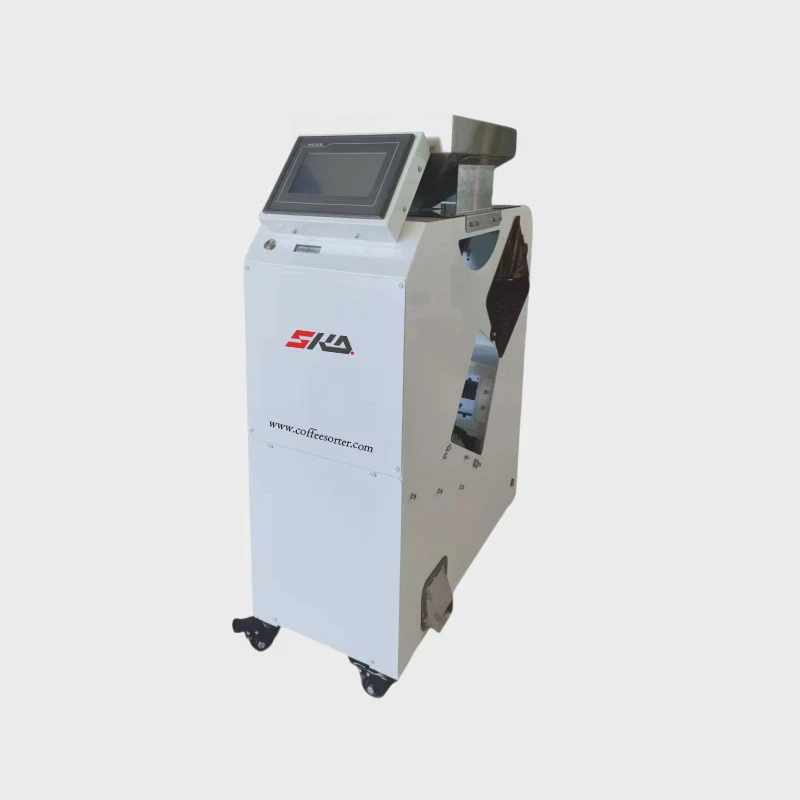
The SKA-16 runs 30-60 kg/h on 0.2 kW, which is a wall outlet, not an electrician visit. Its footprint is roughly 330 x 700 x 1000 mm, about the size of a commercial espresso grinder, so it lives on a bench near the roaster instead of in a processing hall.
A four-hour sorting session on one puts out 120 to 240 kg of finished green or roasted coffee, which matches how specialty buyers actually work: by the 60-kilo bag, by the lot, by the sample approval. Switching recipes between lots is routine because the touchscreen keeps a profile per bean, and a small machine rewards that habit.
What changes at industrial scale
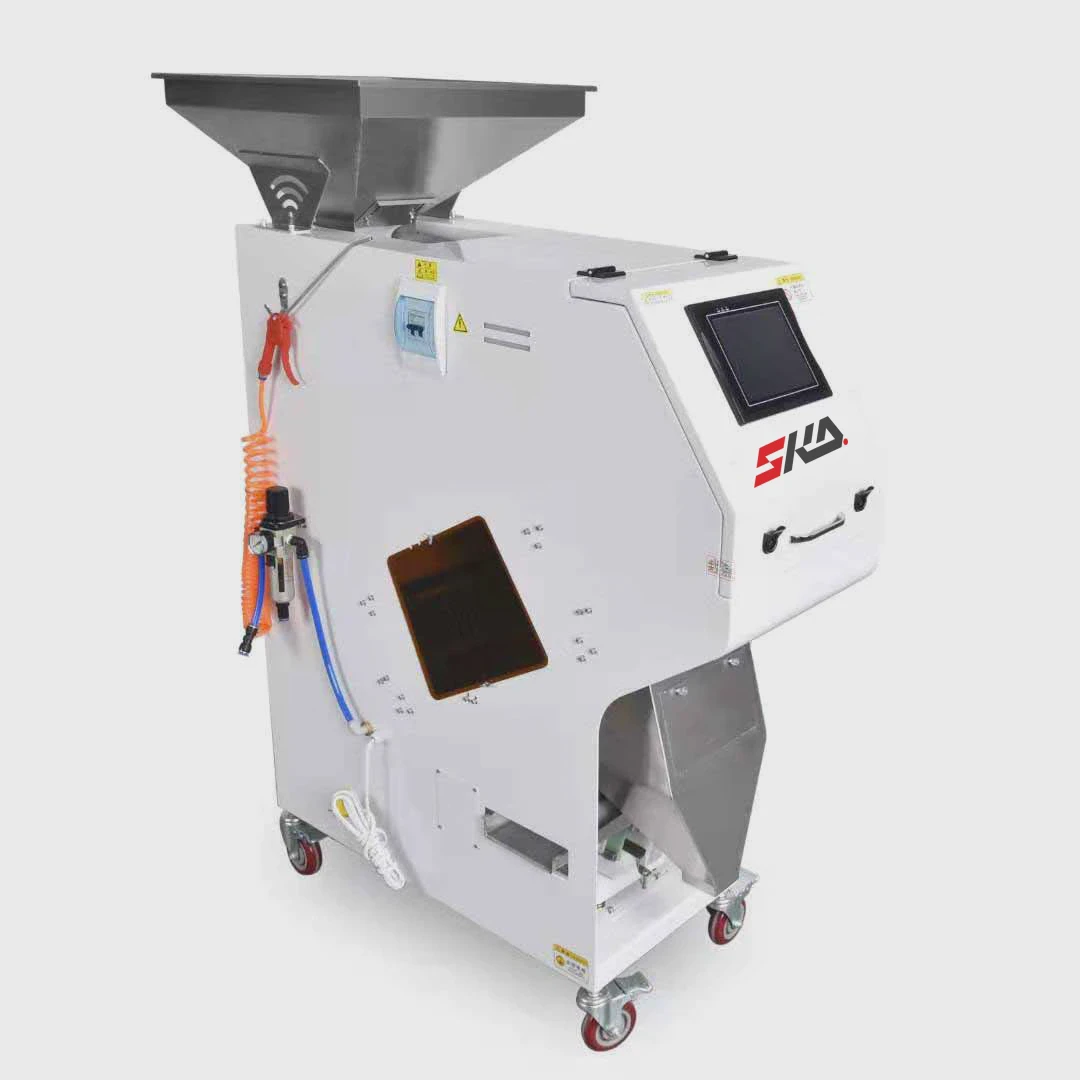
Cross the 0.5 t/h mark and the sorter stops being an appliance and starts being infrastructure. The SKA-2A128 moves 1 t/h on 1.8 kW and wants a 220V supply plus a clean, dry compressed-air line at 0.5-0.8 MPa. The K64C and K128C go up to 2-2.5 t/h and expect steady feeding from a hopper or elevator, because at that rate a person with a bucket becomes the bottleneck.
Two other things change quietly. Downtime gets expensive: an hour lost on a 1 t/h line is a ton of backlog, so spare parts and remote support stop being optional. And the model-training habits you built on a small machine have to survive staff turnover, because whoever feeds the hopper at 6 a.m. is not the person who trained the AI.
Match the machine to your worst week, not your best one
- Write down the tons you actually sort per day right now. Keep the tons you wish to sort in three years on a separate sheet.
- Divide by the hours you really run. Three tons spread over a 10-hour season day is 0.3 t/h, which is a mid-size machine, not an industrial one.
- Check the room before the catalog: door width, floor space, outlet type, and whether a compressor already exists.
- Look at your lot pattern. Frequent small lots argue for a smaller, faster-to-switch machine even when a big one could technically swallow the volume.
- Compare rated capacity last, and leave 20-30% headroom.
The loading rule from our capacity guide still applies inside whichever class you pick: run at 70-80% of rated capacity, not at 100%.
Three classes, in one table
| Class | Model | Rated capacity | Power | Footprint (W x D) | Lives well at |
|---|---|---|---|---|---|
| Small | SKA-16 | 30-60 kg/h | 0.2 kW (plug) | 330 x 700 mm | Roastery bench, QC lab, micro-lots |
| Mid | SKA-32 | 0.3 t/h | 0.7 kW | 450 x 1100 mm | Small mills, single-origin stations |
| Mid | SKA-1A64 | 0.3-0.5 t/h | 1 kW | 800 x 1260 mm | Cooperative pools, small export lots |
| Industrial | SKA-2A128 | 1 t/h | 1.8 kW | 1152 x 1697 mm | Washing stations, mid exporters |
| Industrial | K64C | 1-2 t/h | 110/220 V | Single vertical chute | AI shape+color, specialty grade |
| Industrial | K128C | 2-2.5 t/h | 110/220 V | 1450 x 1450 mm (packed) | Export plants, container schedules |
All capacities are rated on standard material. Your effective number depends on defect ratio, moisture and target purity, which the price guide covers alongside what each class costs.
The middle ground most buyers skip
The question we hear most after this table: "we're between the two." That usually means buying the mid tier and planning a second machine later, instead of one oversized unit paying rent on power, air and floor space you never fill. The ROI worksheet does the full math; the short version is that two small lines rarely idle at the same moment, while one big line idles every time anything happens to it.
FAQ
Is a small sorter less accurate than an industrial one?
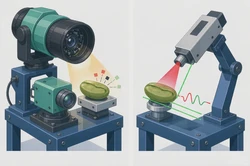
No. Every SKA sorter uses the same full-color CCD and AI recognition, and accuracy is quoted at 99.9% measured on standard material across the range. The small machines differ in chute width and feed rate, not in what the camera can see.
Can the SKA-16 sort roasted coffee, or only green?
Both, like every model in the line. Roastery operators usually run it after roasting for quakers and scorched beans, or before roasting for defect control on green.
What does an industrial installation need that a small one doesn't?
220V supply, a compressor sized to the valve bank at 0.5-0.8 MPa of clean, dry air, a steady feed hopper or elevator, and 2 to 5 square meters of solid floor. Ask us for the air and power checklist before the machine ships, not after.
When should a roastery outgrow a small machine?
When the SKA-16 runs full shifts for weeks at a stretch, or when you start sorting for other roasters. Either one means your real demand moved to the 0.3 t/h class. It doesn't mean you bought wrong.
Next steps
Send us three facts: a typical day of sorted volume, the room you have, and the power and air you can install. We'll tell you which class fits, including the answer we'd rather not give when the honest one is "you don't need a bigger machine." The buying guide covers the rest of what to check before you invest. Request a quote or message us on WhatsApp for a fast answer.