Coffee Bean Size Grading: Screen Size vs Optical Sorting
Coffee bean size grading and optical sorting solve two different problems. One measures how big the bean is. The other judges what the bean looks like. Most export specifications ask for both, so a dry mill usually needs a screen stage and an optical stage rather than one machine doing both jobs.
This guide explains what screen size means, what a grader can and cannot separate, where a coffee color sorter fits, and how to test both stages on your own green coffee before you commit to equipment.
What screen size means in coffee grading
Screen size is a green coffee grade based on bean width. The number comes from the width of the slot the bean passes through, counted in sixty-fourths of an inch, so a screen 17 slot is about 6.75 mm wide.
A grader passes the lot over a set of slotted screens. Beans that fall through a given screen but stay on the next one down are collected as that grade. The common screen range looks like this:
| Screen | Approximate slot width | How it is usually treated |
|---|---|---|
| 13 | about 5.16 mm | Smaller beans, often sold at a lower grade |
| 14 | about 5.56 mm | Common in many washing station lots |
| 15 | about 5.95 mm | Mid grade |
| 16 | about 6.35 mm | Mid to large grade |
| 17 | about 6.75 mm | Large grade |
| 18 | about 7.14 mm | Large grade where the lot produces it |
Grade names are not universal. Some origins and buyers use letters such as AA, AB or PB, some describe the lot by screen number, and some write a screen range into the contract. Always work from the written specification you have to meet, not from a general rule of thumb.
Why size is written into a coffee contract
Size is not only about appearance. A lot with a narrow size range behaves more predictably in a roaster, because beans of similar size take heat at a similar rate. A wide spread means some beans are underdeveloped while others are already too dark at the same roast time.
Size also affects how the lot is priced and how it is described to a buyer. Mixed grades are usually sold at a discount, and a buyer who ordered screen 16 and above will not accept a lot that carries a large share of screen 13.
Size alone is not quality. A screen 17 lot can still contain black beans, sour beans, insect damage, stones and sticks. That is why grading is normally followed by other separation stages.
What a screen grader does, and where it stops
A grader separates by dimension. Flat screens sort by bean width, and thickness or slotted decks can separate flat beans from round ones. Done properly, grading gives repeatable fractions that match the size clause of a contract.
The limits are just as important:
- It does not judge colour. A black bean and a healthy bean of the same width land in the same fraction.
- It does not judge surface or internal condition. Mould damage, insect damage and fermentation defects are invisible to a screen.
- A stone of similar size passes through with the coffee. Density equipment handles that job better.
- Broken and chipped beans can stay in the fraction when the remaining piece is close to the slot width.
What optical sorting adds on top of size grading
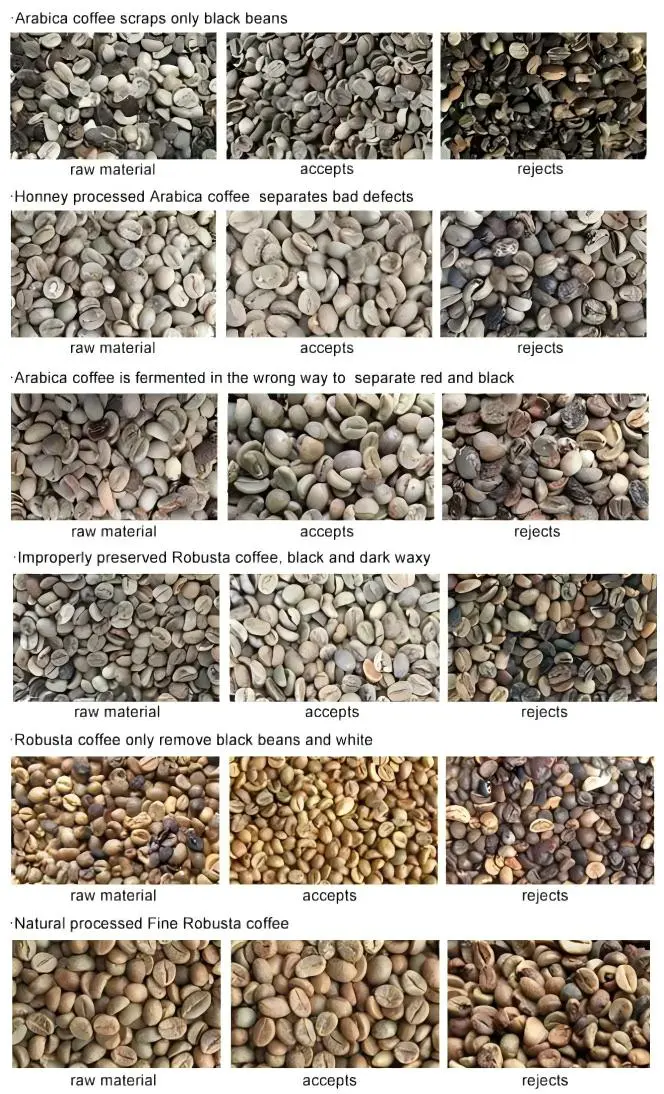
A coffee color sorter inspects each piece in a controlled viewing area and ejects the ones that fall outside the selected acceptance profile. It works on colour, surface condition and shape, not on a slot width.
In practice that covers:
- Black, sour, mould damaged and insect damaged beans inside a single screen fraction.
- Discoloured or faded beans that fail the appearance clause of a contract.
- Stones, sticks, husk, glass and plastic pieces that contrast with the coffee.
- Off shape material, within the limits of what the camera can see.
The result depends on contrast, orientation, surface condition, lighting, feed presentation and machine settings. A brown stick that closely matches the coffee, or a transparent fragment against a similar background, is harder to separate than a bright stone on a clean background. Optical sorting does not see inside the bean, so hidden internal damage still needs lot quality control and cup evaluation.
Screen grading vs optical sorting
| Point | Screen grading | Optical sorting |
|---|---|---|
| Separates by | Bean width or thickness | Colour, surface condition and shape |
| Main output | Size fractions such as screen 15, 16, 17 | Accepted product plus a reject stream |
| Removes well | Oversized, undersized and off thickness material | Colour defects, visible foreign matter with contrast |
| Does not remove | Colour defects, same size stones, internal damage | Internal damage, same colour foreign matter |
| Typical position | Early, before inspection stages | Later, as a final optical quality gate |
Where each stage sits in a dry mill
A practical order for dried cherry coffee is:
- Hulling and polishing to take the lot down to green coffee.
- Screen grading to produce the size fractions the contract asks for.
- Density or gravity separation where stones and heavy mineral matter are a known problem.
- Optical sorting on each fraction that has to meet an appearance or defect limit.
- Sampling and inspection of both the accepted lot and the reject stream.
- Packing and export documentation.
Grading first usually helps the sorter. A single size fraction feeds more evenly, sits more consistently in the viewing area, and can be set for the defects that actually occur in that fraction. Removing heavy stones upstream also keeps large hard objects away from the ejection stage.
How to test grading and sorting on your own beans
Use your own material, and test the fractions separately. A clean demonstration sample tells you nothing about a lot that carries 8 percent defects.
- Split the sample by screen fraction before testing, so you see how each grade behaves.
- State the target: throughput, defect categories, acceptable carry out, and whether the test is single pass or double pass.
- Inspect the reject stream. You need to see what leaves the product and how much good coffee goes with it.
- Record the conditions: material description, moisture if available, feed rate, air pressure, sensitivity setting, pass count and sample size.
- Repeat the same check after installation so the factory test and the production result can be compared.
Our coffee defect rate testing guide explains detection rate, carry out and throughput in more detail. Those three numbers should be read together, because a high detection figure with heavy good product loss is not a usable result.
How SKA fits into a grading line
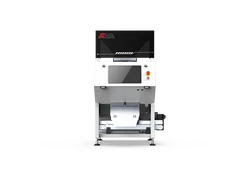
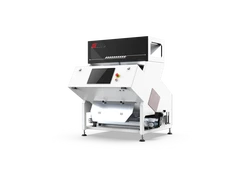
SKA builds the optical stage. Our coffee color sorters cover 30 kg per hour to 2.5 tons per hour across the listed configurations, and they are used as a final quality gate after mechanical cleaning and grading. We do not build screen graders, and we do not claim that one sorter replaces the grading, density and food safety controls that sit around it.
We do not print one unconditional accuracy figure for every coffee lot. Send representative beans, tell us the screen fractions you sell and the defects you need out, and we can test the material, show the reject stream and discuss carry out before you decide.
See the coffee color sorter range, check what throughput you need, compare the CCD and NIR options, or contact SKA for a sample test.