
Coffee Processing Equipment Trends 2026: Automation and AI
Coffee processing equipment trends in 2026 are less about new machine names and more about what a supplier can prove. Buyers are asking for documented acceptance tests, reject stream reviews and written support terms instead of a longer feature list.
This article covers the changes that matter in a coffee line, where AI actually fits, and the questions to put to a supplier before an order is signed.
What is changing in coffee processing lines
A coffee processing line is a set of stages that each remove one class of problem. The useful shift is a clearer split of those stages, not a single machine claiming to cover all of them.
After drying, a typical export line handles hulling, size grading, density separation, optical sorting, sampling and packing. Screens separate by size, density equipment handles heavy mineral matter, and a color sorter judges colour and surface condition. When one of those jobs is skipped, the next machine is asked to solve a problem it was not built for.
That is why more specifications now name each stage and its acceptance limit. A lot sold as screen 17/18 with a visual defect limit needs a line that can be checked stage by stage.
Sensors, ejection and where AI fits
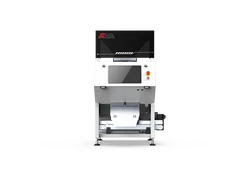
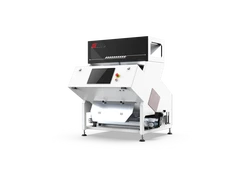
Optical sorting is a sensor decision before it is a software decision. CCD cameras inspect visible colour and surface defects. NIR sensors can help where material differs in a way visible light does not show clearly. Which one you need depends on the defects in your own lot, not on the newest label in a brochure.
AI and self learning functions are available on AI equipped models only. They are not standard across a whole product range, and they do not remove the need for representative sample testing. If a plant rarely changes varieties or defect patterns, a simpler configuration may be the better purchase. Compare the CCD and NIR options against the defects you actually see.
The ejection side matters just as much. Ask how the machine presents material to the camera, how the reject stream is separated, and whether good coffee loss can be measured during a test. A high detection number with heavy carry out is not a usable result.
Acceptance testing is becoming part of the specification
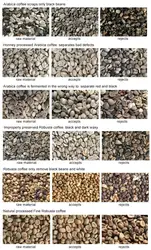
Sample testing is a practical acceptance method: the supplier runs the buyer material and both sides inspect what was removed and what was lost.
Three numbers should be read together: detection of the target defect, carry out of good product into the reject stream, and throughput at the feed rate used in the test. Our coffee defect rate testing guide explains how these fit together.
We do not print one unconditional accuracy figure for every coffee lot. Where an accuracy figure is quoted, it belongs to a standard test material under stated conditions. The number that matters for a purchase is the one measured on the buyer material, and it should be written into the acceptance record.
Data recording and traceability
Record the material description, screen fraction, moisture if available, feed rate, air pressure, sensitivity setting, pass count and sample size. Keep the accepted product and reject product traceable during the test.
Some export buyers also ask for lot records that follow the shipment. That is a documentation habit, not a machine feature. If a lot is questioned later, a recorded test method is more useful than a brochure claim.
Remote commissioning and written support terms
Support is part of the purchase decision, especially for plants far from the factory. The terms we publish are specific:
- 12 months warranty on the complete machine, with the start date confirmed in writing at order.
- Remote installation guidance and operator training. An on site engineer visit is a separate item to be agreed and quoted before the order.
- Spare parts shipped with the machine, plus a spare parts price list for later orders.
- WhatsApp service contact with a 24 hour response.
- Post warranty maintenance policy is discussed with the sales manager.
Ask any supplier to put equivalent terms in writing. If a clause is missing, resolve it before payment, not after installation. Our warranty and after sales guide lists the questions worth asking.
Matching capacity to the lot
SKA coffee color sorters cover 30 kg per hour to 2.5 tons per hour across the listed configurations. Bigger is not automatically better. Peak season volume, shift length, the number of screen fractions sorted separately and available floor space all change the right choice.
Use the capacity guide to work from lot volume back to a machine size, then confirm the number with a sample test at that feed rate.
What to ask a supplier in 2026
| Question | Why it matters | What to request |
|---|---|---|
| Which defects can this machine remove? | Defines the scope of the optical stage | A test on your material with a reject stream review |
| Is AI fitted on this configuration? | AI is limited to AI equipped models | Written configuration list |
| What accuracy figure applies, and to what material? | A figure without a test condition is not comparable | Stated test material, settings and pass count |
| How much good coffee leaves in the reject stream? | Detection alone does not describe the cost | Carry out measurement during the test |
| What is included in installation and training? | Remote and on site support are different items | Written scope and any separate quotation |
| What parts ship with the machine? | Downtime often waits on a small part | Spare parts list and price list |
How SKA approaches these changes
SKA builds coffee processing equipment, with manufacturing in Anhui and sales, export and after sales support from Ningbo. CE certification and ISO 9001 manufacturing are part of the documented background we give buyers. We supply the optical sorting stage, not a complete dry mill, and we state where our machines fit in the wider line.
We do not add market statistics or customer stories to a proposal. Send representative beans, state the defects and throughput you need to handle, and we can test the material, show the reject stream and discuss the result before you decide.
The coffee processing equipment trends worth acting on all lead to the same habit: test your own material first, then write the result into the contract.
See the coffee color sorter range, read how a color sorter works, or contact SKA for a sample test.